AI at Work Across Five Generations: What the Research Actually Shows

AI at Work Across Five Generations: What the Research Actually Shows

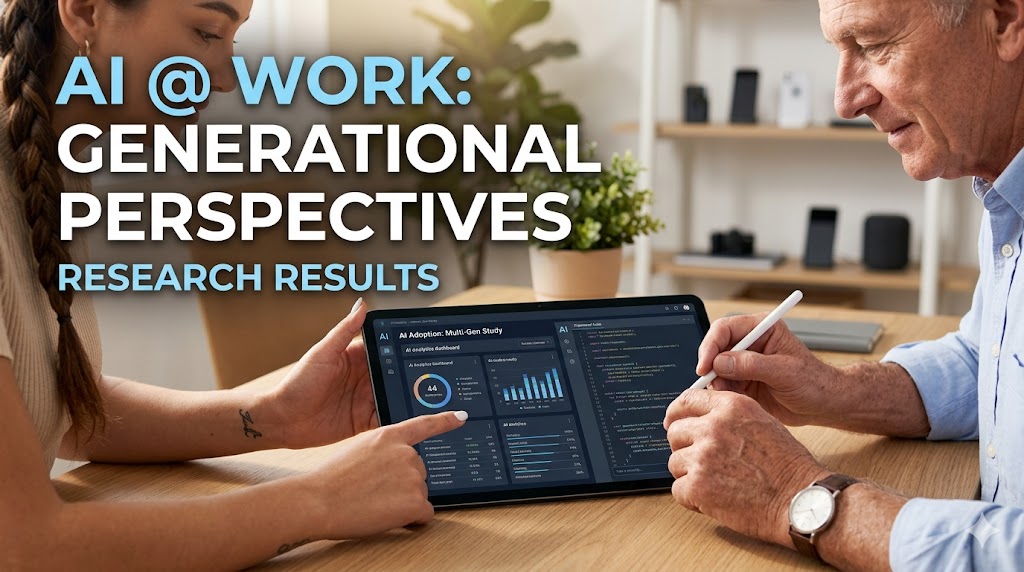
Artificial intelligence is entering workplaces quickly, and many organizations are trying to understand how employees across different age groups are responding.

Popular narratives often suggest that these generations are reacting to AI in dramatically different ways. However, recent workplace research tells a more balanced story. The differences that appear across generations are usually connected to digital fluency, career stage, perception of risk, and previous experience with technological change rather than inherent traits tied to age.

For leaders and organizations, this distinction matters because it changes how AI adoption should be approached. When differences are understood as contextual rather than fixed, it becomes possible to design strategies that support the entire workforce while reducing unnecessary friction or anxiety.

Shared values, different approaches to technology

Employees across generations share many of the same core workplace priorities. Modern workforce trends indicate that most employees, regardless of age group, value job stability, meaningful work, and being treated with respect at work. What differs more noticeably is how people prefer to communicate, how they learn new tools, and how comfortable they feel experimenting with emerging technologies.

Communication style is one of the most visible distinctions across generations. Studies on workplace collaboration note that younger workers often favor digital and asynchronous communication channels, while many older employees continue to value direct conversation or more structured interactions. These differences can become especially important when organizations introduce AI tools that require onboarding, experimentation, and ongoing training.

When training approaches do not align with how employees prefer to learn, adoption slows and techno-stress increases. Organizations that tailor support structures across communication styles often see higher engagement with new technologies across the workforce.

Generation Z and the rise of AI-related stress

Generation Z is frequently described as a group that grew up with technology and therefore adopts new tools quickly. While this is partially true, research suggests a more complex reality. Many Gen Z professionals express both curiosity about AI and concern about how it may affect their long-term career stability.

Studies examining early career professionals show that Gen Z workers report heightened anxiety about the future of work in an AI-driven economy. One explanation is that many younger employees have not yet experienced previous technological shifts that eventually created new job categories and opportunities. Older workers have lived through multiple waves of workplace change, such as the rise of personal computers, enterprise software, and cloud based systems. These experiences often provide context that technological change can lead to new roles rather than permanent displacement.

Researchers have begun describing this phenomenon as “AI stress,” a form of techno-stress connected specifically to generative AI tools. This stress includes concerns about skill relevance, fears of job displacement, and questions about how closely humans should collaborate with automated systems. Many young employees recognize AI’s potential productivity benefits while simultaneously worrying about how it may reshape professional identity and long-term employability.

Millennials and the strongest positive outcomes from AI use

Among the five generations currently working, Millennials appear to experience some of the most positive workplace outcomes when using AI tools. Analysis of OECD AI survey data across seven countries found that Millennials reported the largest improvements in several areas of well being when AI was integrated into their work. These improvements included increases in job enjoyment, mental health, and perceptions of physical safety, with reported benefits ranging from 8.9 percent to 21.3 percent depending on the category measured.

Millennials developed digital skills early in their careers while also gaining enough professional experience to evaluate AI as a tool that enhances human decision making rather than replacing it. This aligns with broader findings showing that strong digital skills often predict what researchers call an augmentation focused perspective on AI. In this view, AI is seen primarily as supporting human capability rather than competing with it.

Because many Millennials now hold mid-level leadership roles, their perspective often influences how teams integrate new technologies into daily work processes.

Older workers, digital learning, and the myth of resistance

Discussions about AI adoption assume that older workers struggle significantly with new technologies. However, studies examining digital learning in later career stages show that age-based stereotypes about technology competence are often inaccurate. With appropriate supervisor support and training designed for different learning styles, older employees can achieve high levels of digital fluency.

When adoption slows among Baby Boomers or Traditionalists, the cause is frequently connected to how technology is introduced rather than an inherent reluctance to learn. If AI tools appear disconnected from daily responsibilities or if employees are expected to adopt them without context, individuals may disengage because the technology feels irrelevant to their work rather than because they fear it.

Interestingly, research examining AI exposure among highly educated older workers in Europe found that greater exposure to AI was associated with a lower likelihood of early retirement. This suggests that when organizations invest in upskilling and meaningful integration of new technologies, employees may remain engaged in the workforce longer.

The future of work remains deeply human

While AI is expected to reshape many job functions, research consistently shows that not all roles are equally exposed to automation. Occupations involving routine administrative work are more likely to see higher levels of AI integration, while roles that rely on complex problem solving, emotional intelligence, and interpersonal collaboration remain more resilient.

This insight offers an important perspective for organizations navigating technological change. The future of work is not defined by competition between humans and machines. Instead, it is increasingly shaped by how effectively organizations cultivate the capabilities that technology cannot replicate.

When leaders approach AI adoption with transparency, thoughtful training, and respect for the experiences that employees bring at different career stages, the presence of five generations in the workforce becomes a strength rather than a challenge. Organizations that recognize this dynamic are better positioned to adapt to rapid technological change while maintaining trust, engagement, and long-term resilience.


Five Generations at Work: What Organizations Need to Understand Now

Five Generations at Work: What Organizations Need to Understand Now

The contemporary U.S. workforce is experiencing something historically unusual and strategically important. For the first time, five generations are working side by side in meaningful numbers: the Silent Generation (born 1928 to 1945), Baby Boomers (1946 to 1964), Generation X (1965 to 1980), Millennials (1981 to 1996), and Generation Z (1997 to 2012). Each group entered adulthood during different economic cycles, technological shifts, and cultural moments, which naturally shaped how they approach work, leadership, communication, and professional growth.

For organizations, this reality can feel complex at first glance. At the same time, it presents a significant opportunity to build stronger teams, preserve institutional knowledge, and strengthen long-term performance when leaders approach generational dynamics with intention and care.

Labor force data reflects this shift clearly. Surveys and workforce analysis indicate that by 2025 to 2026, roughly one third of the U.S. workforce is made up of Millennials, while Generation Z continues to enter the workforce at a rapid pace. Simultaneously, Baby Boomers and some members of Generation X are remaining active in their careers beyond age sixty-five.

The presence of older workers, in particular, has grown significantly. According to a CNBC analysis of data from the U.S. Bureau of Labor Statistics, the number of employed Americans aged sixty-five and older increased by more than thirty-three percent between 2015 and 2024. During that same period, the overall labor force grew by roughly nine percent. By 2024, more than eleven million workers in the United States were age sixty five or older, and labor economists expect this number to continue rising as the large Baby Boomer population moves through later career stages.

This combination is what produces the multigenerational workplace that organizations are navigating today.

One of the most important factors shaping today’s workforce is the changing nature of retirement. For many decades, retirement functioned as a clear transition point that marked the end of a professional career. Today, that model has gradually shifted into something more fluid and gradual. Many individuals move into retirement through phased transitions, part-time work, consulting roles, or entirely new ventures rather than leaving the workforce all at once. Researchers and labor economists note that this shift is influenced by both economic and personal factors that affect how individuals plan their later years.

Financial considerations is also one of the primary drivers behind extended workforce participation among older adults. Rising healthcare costs, the decline of traditional pension structures, and reliance on defined contribution plans such as 401(k) accounts have created a landscape where many individuals choose or need to remain professionally active longer. Concerns about long-term financial stability and the sustainability of Social Security programs also contribute to this decision-making process, according to labor market research examining retirement trends in the United States.

Beyond financial realities, work also plays a meaningful role in how people experience purpose, identity, and connection. Many individuals find that their career provides intellectual stimulation, community, and a sense of contribution that continues to matter later in life. Because of this, leaving work abruptly can create a loss of structure and belonging. As a result, more professionals are choosing bridge roles, advisory positions, and flexible arrangements that allow them to remain engaged while adjusting the pace of their work.

These trends have important implications for leadership, workforce planning, and organizational culture. When five generations work together, assumptions can quickly form about communication preferences, work ethic, adaptability, or comfort with technology. However, research in organizational psychology suggests that many commonly cited generational stereotypes are not strongly supported by evidence when examined through large-scale meta-analyses. In practice, individuals within the same generation often vary widely in their motivations and work styles.

Because of this, effective leadership in a multigenerational workplace requires something more thoughtful than simply categorizing employees by age group. Organizations benefit most when leaders focus on adaptable management practices that respond to the needs of people as individuals while still understanding broader patterns in workforce trends.

When viewed as a whole, the multigenerational workforce is not to be seen as a problem to manage but rather as a system that requires thoughtful leadership. The organizations that tend to perform best in this environment are those that invest in communication across experience levels, design work in ways that support different life stages, and create pathways for shared learning that benefit the entire workforce.

The reality is that the future of work will continue to include multiple generations working together for longer periods of time. Organizations that understand these shifts early are better positioned to adapt, retain talent, and build teams that are capable of navigating ongoing change.

For leaders and organizations, the question is no longer whether generational dynamics will influence the workplace. The more relevant question is how intentionally those dynamics are understood and supported. When approached thoughtfully, the presence of five generations at work can become one of the most valuable strengths an organization has.

Why So Many Adults Are Just Now Getting Answers About ADHD and Autism

Why So Many Adults Are Just Now Getting Answers About ADHD and Autism

Have you ever heard someone say, “I only figured this out about myself in my 30s,” and realized they were not talking about a preference or a personality trait, but about something that shaped their entire life experience?

Across the United States, more adults are coming to understand their minds in ways that were not available to them in childhood. For many, that understanding comes through a diagnosis of ADHD or autism later in life. What the data now makes clear is that this is not an exception or an outlier story but a pattern, and it carries important implications for how individuals, workplaces, and systems think about support, performance, and well-being.

ADHD and Autism in Adults: A Growing Pattern of Later Recognition  

In America, both ADHD and autism are being identified more in adulthood, and the data suggest this is becoming a defining pattern rather than an exception.

Recent Centers for Disease Control and Prevention (CDC) data show that about 15.5 million U.S. adults, or 6.0% of the population, have a current ADHD diagnosis. More than half of those adults, 55.9%, were diagnosed in adulthood. At the same time, about one-third of adults with ADHD are not receiving treatment, and many who are prescribed medication report difficulty accessing it due to ongoing shortages.

The same pattern of later recognition is emerging in autism. A CDC-linked estimate suggests about 2.21% of U.S. adults are autistic, or roughly 1 in 45 people. More recent health system data published in JAMA Network Open found that autism diagnoses increased significantly between 2011 and 2022, rising from 2.3 per 1,000 to 6.3 per 1,000 individuals. The most notable increases were seen among young adults, particularly those aged 26 to 34, along with a faster rise in diagnoses among women.

These trends point to a shared reality across both ADHD and autism: many people are not identified in childhood, but in adulthood, often after years of navigating school, work, and relationships without a clear explanation for their experiences.

There are also consistent patterns in who is most likely to be missed. Women are more likely to receive both ADHD and autism diagnoses later in life, often after being misunderstood or labeled in other ways. Young adults are also seeing increased rates of diagnosis as awareness grows and access to evaluation improves. At the same time, disparities in access to care suggest that racial and ethnic differences in diagnosis rates may reflect structural barriers in screening and referral pathways rather than true differences in prevalence.

What connects these trends is not just increased awareness, but the reality that both ADHD and autism can look different in adults than they do in children. Executive functioning challenges, sensory sensitivities, emotional regulation difficulties, and social exhaustion are often interpreted through the lens of stress, anxiety, or burnout. As a result, many people only begin to receive clarity when life demands exceed the coping strategies they have been relying on for years.

The Role of Leadership Accountability and Psychological Safety  

For organizations, this data is not just informational. It calls for action.

Leadership accountability means recognizing that many employees are navigating work environments without having been fully understood earlier in life. It requires leaders to move beyond assumptions about productivity, communication styles, and performance.

Psychological safety plays a critical role in this shift. When individuals feel safe to share their needs without fear of judgment or consequence, they are more likely to seek support, use available resources, and contribute in ways that align with their strengths.

This is not about lowering expectations. It is about aligning expectations with reality and providing the conditions that allow people to meet them.

The Big Picture

The data tells a clear story. Late diagnosis is not a rare occurrence and it is defining the current landscape for ADHD and autism in the United States.

A significant portion of adults are only now gaining access to language, frameworks, and support that help them understand their experiences. Many were missed not because they lacked need, but because systems were not designed to recognize them.

For individuals, this moment offers clarity and the possibility of more aligned support. For organizations, it presents an opportunity to rethink how environments are structured, how performance is evaluated, and how people are supported over time.

The shift forward is not complex, but it is meaningful. It begins with awareness, continues with accountability, and grows through environments where people feel safe enough to be understood as they are.

And from there, everything else becomes more possible.

Why Phrases Like “I’m So OCD” or “I’m Depressed” Deserve a Second Thought 

Why Phrases Like “I’m So OCD” or “I’m Depressed” Deserve a Second Thought

Have you ever heard someone say, “I’m so OCD,” or “That made me depressed,” in the middle of an everyday conversation? These phrases tend to come up casually, often as a quick way to describe habits, preferences, or emotional reactions.

Most of the time, there is no intention to cause harm. These expressions have become part of how people communicate, shorthand for being organized, distracted, or having a rough day. Yet even when the intent is light, the impact can be more complex. Words that are tied to real mental health conditions can carry a weight that is easy to overlook in casual conversation.

This is not about correcting people or limiting expression but about understanding how language influences perception and how small shifts in the way we speak can lead to more thoughtful, accurate, and human-centered conversations.

What These Terms Actually Represent  

Clinical terms like OCD, ADHD, and depression are not interchangeable with everyday traits or temporary emotions. They describe conditions that can significantly affect a person’s daily life.

Obsessive-Compulsive Disorder involves more than a preference for neatness or structure. It includes recurring, intrusive thoughts and repetitive actions that are often performed to ease anxiety. For many individuals, these patterns can be exhausting and time-consuming.

Attention-Deficit/Hyperactivity Disorder is not simply about losing focus from time to time. It is a neurological condition that can impact attention, organization, impulse control, and the ability to follow through on tasks. What may appear to be a distraction on the surface often reflects a much deeper challenge in executive functioning.

Depression also extends far beyond feeling sad. It can influence energy levels, motivation, sleep, appetite, and a person’s sense of connection or purpose. For some, it makes even the most basic parts of daily life feel difficult to navigate.

Recognizing the difference between a passing feeling and a clinical condition helps us better understand why these distinctions matter.

How Casual Language Can Shift Understanding  

Language shapes how we make sense of the world and of one another. When diagnostic terms are used loosely, it can unintentionally blur the line between everyday experiences and conditions that require care and support.

Over time, this can lead to oversimplified understandings. OCD becomes associated only with cleanliness. ADHD gets reduced to restlessness or distraction. Depression is equated with a temporary low mood. These narratives can take hold in subtle ways, influencing how people interpret what they see in others and even in themselves.

There is also an impact on how safe people feel sharing their experiences. When certain terms are frequently used as exaggerations or jokes, individuals who live with those conditions may hesitate to speak openly. They may question whether they will be taken seriously or fully understood.

In a broader sense, this kind of language can make it harder to recognize when someone is actually in need of support. If every stressful moment is described as “trauma” or every anxious feeling is labeled as a “panic attack,” the meaning of those terms can become diluted.

Moving Toward Mindful Communication  

For many people, this kind of language is simply habitual. It reflects what we hear around us rather than a conscious choice. That means change does not require judgment. It begins with awareness.

When we model more intentional language, we create space for others to reflect as well. These small shifts can gradually shape a culture where conversations around mental health feel more grounded and respectful.

That shift starts with something as simple and as powerful as the words we choose.

Skip to content