AI at Work Across Five Generations: What the Research Actually Shows

AI at Work Across Five Generations: What the Research Actually Shows

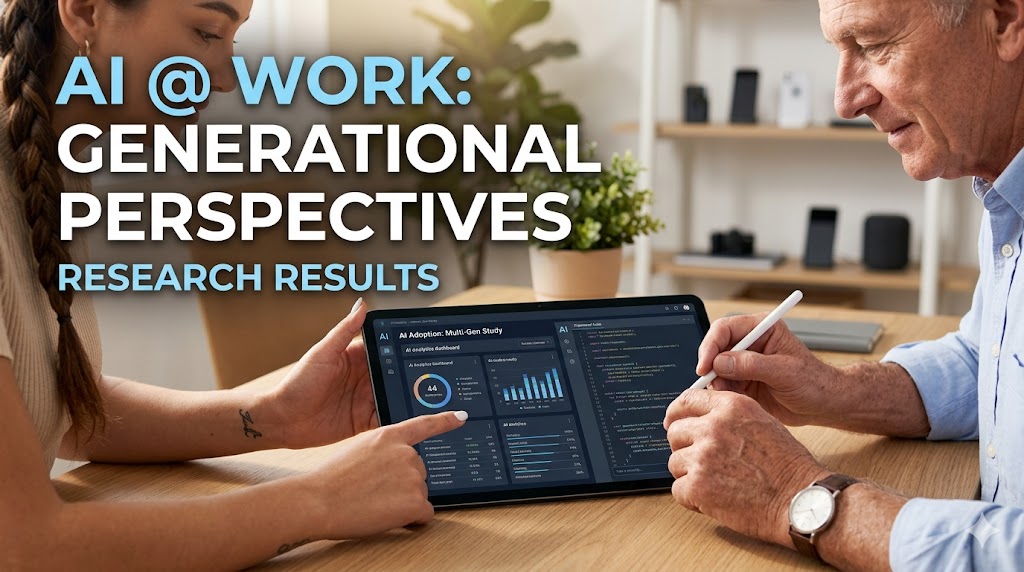
Artificial intelligence is entering workplaces quickly, and many organizations are trying to understand how employees across different age groups are responding.

Popular narratives often suggest that these generations are reacting to AI in dramatically different ways. However, recent workplace research tells a more balanced story. The differences that appear across generations are usually connected to digital fluency, career stage, perception of risk, and previous experience with technological change rather than inherent traits tied to age.

For leaders and organizations, this distinction matters because it changes how AI adoption should be approached. When differences are understood as contextual rather than fixed, it becomes possible to design strategies that support the entire workforce while reducing unnecessary friction or anxiety.

Shared values, different approaches to technology

Employees across generations share many of the same core workplace priorities. Modern workforce trends indicate that most employees, regardless of age group, value job stability, meaningful work, and being treated with respect at work. What differs more noticeably is how people prefer to communicate, how they learn new tools, and how comfortable they feel experimenting with emerging technologies.

Communication style is one of the most visible distinctions across generations. Studies on workplace collaboration note that younger workers often favor digital and asynchronous communication channels, while many older employees continue to value direct conversation or more structured interactions. These differences can become especially important when organizations introduce AI tools that require onboarding, experimentation, and ongoing training.

When training approaches do not align with how employees prefer to learn, adoption slows and techno-stress increases. Organizations that tailor support structures across communication styles often see higher engagement with new technologies across the workforce.

Generation Z and the rise of AI-related stress

Generation Z is frequently described as a group that grew up with technology and therefore adopts new tools quickly. While this is partially true, research suggests a more complex reality. Many Gen Z professionals express both curiosity about AI and concern about how it may affect their long-term career stability.

Studies examining early career professionals show that Gen Z workers report heightened anxiety about the future of work in an AI-driven economy. One explanation is that many younger employees have not yet experienced previous technological shifts that eventually created new job categories and opportunities. Older workers have lived through multiple waves of workplace change, such as the rise of personal computers, enterprise software, and cloud based systems. These experiences often provide context that technological change can lead to new roles rather than permanent displacement.

Researchers have begun describing this phenomenon as “AI stress,” a form of techno-stress connected specifically to generative AI tools. This stress includes concerns about skill relevance, fears of job displacement, and questions about how closely humans should collaborate with automated systems. Many young employees recognize AI’s potential productivity benefits while simultaneously worrying about how it may reshape professional identity and long-term employability.

Millennials and the strongest positive outcomes from AI use

Among the five generations currently working, Millennials appear to experience some of the most positive workplace outcomes when using AI tools. Analysis of OECD AI survey data across seven countries found that Millennials reported the largest improvements in several areas of well being when AI was integrated into their work. These improvements included increases in job enjoyment, mental health, and perceptions of physical safety, with reported benefits ranging from 8.9 percent to 21.3 percent depending on the category measured.

Millennials developed digital skills early in their careers while also gaining enough professional experience to evaluate AI as a tool that enhances human decision making rather than replacing it. This aligns with broader findings showing that strong digital skills often predict what researchers call an augmentation focused perspective on AI. In this view, AI is seen primarily as supporting human capability rather than competing with it.

Because many Millennials now hold mid-level leadership roles, their perspective often influences how teams integrate new technologies into daily work processes.

Older workers, digital learning, and the myth of resistance

Discussions about AI adoption assume that older workers struggle significantly with new technologies. However, studies examining digital learning in later career stages show that age-based stereotypes about technology competence are often inaccurate. With appropriate supervisor support and training designed for different learning styles, older employees can achieve high levels of digital fluency.

When adoption slows among Baby Boomers or Traditionalists, the cause is frequently connected to how technology is introduced rather than an inherent reluctance to learn. If AI tools appear disconnected from daily responsibilities or if employees are expected to adopt them without context, individuals may disengage because the technology feels irrelevant to their work rather than because they fear it.

Interestingly, research examining AI exposure among highly educated older workers in Europe found that greater exposure to AI was associated with a lower likelihood of early retirement. This suggests that when organizations invest in upskilling and meaningful integration of new technologies, employees may remain engaged in the workforce longer.

The future of work remains deeply human

While AI is expected to reshape many job functions, research consistently shows that not all roles are equally exposed to automation. Occupations involving routine administrative work are more likely to see higher levels of AI integration, while roles that rely on complex problem solving, emotional intelligence, and interpersonal collaboration remain more resilient.

This insight offers an important perspective for organizations navigating technological change. The future of work is not defined by competition between humans and machines. Instead, it is increasingly shaped by how effectively organizations cultivate the capabilities that technology cannot replicate.

When leaders approach AI adoption with transparency, thoughtful training, and respect for the experiences that employees bring at different career stages, the presence of five generations in the workforce becomes a strength rather than a challenge. Organizations that recognize this dynamic are better positioned to adapt to rapid technological change while maintaining trust, engagement, and long-term resilience.

Five Generations at Work: What Organizations Need to Understand Now

Five Generations at Work: What Organizations Need to Understand Now

The contemporary U.S. workforce is experiencing something historically unusual and strategically important. For the first time, five generations are working side by side in meaningful numbers: the Silent Generation (born 1928 to 1945), Baby Boomers (1946 to 1964), Generation X (1965 to 1980), Millennials (1981 to 1996), and Generation Z (1997 to 2012). Each group entered adulthood during different economic cycles, technological shifts, and cultural moments, which naturally shaped how they approach work, leadership, communication, and professional growth.

For organizations, this reality can feel complex at first glance. At the same time, it presents a significant opportunity to build stronger teams, preserve institutional knowledge, and strengthen long-term performance when leaders approach generational dynamics with intention and care.

Labor force data reflects this shift clearly. Surveys and workforce analysis indicate that by 2025 to 2026, roughly one third of the U.S. workforce is made up of Millennials, while Generation Z continues to enter the workforce at a rapid pace. Simultaneously, Baby Boomers and some members of Generation X are remaining active in their careers beyond age sixty-five.

The presence of older workers, in particular, has grown significantly. According to a CNBC analysis of data from the U.S. Bureau of Labor Statistics, the number of employed Americans aged sixty-five and older increased by more than thirty-three percent between 2015 and 2024. During that same period, the overall labor force grew by roughly nine percent. By 2024, more than eleven million workers in the United States were age sixty five or older, and labor economists expect this number to continue rising as the large Baby Boomer population moves through later career stages.

This combination is what produces the multigenerational workplace that organizations are navigating today.

One of the most important factors shaping today’s workforce is the changing nature of retirement. For many decades, retirement functioned as a clear transition point that marked the end of a professional career. Today, that model has gradually shifted into something more fluid and gradual. Many individuals move into retirement through phased transitions, part-time work, consulting roles, or entirely new ventures rather than leaving the workforce all at once. Researchers and labor economists note that this shift is influenced by both economic and personal factors that affect how individuals plan their later years.

Financial considerations is also one of the primary drivers behind extended workforce participation among older adults. Rising healthcare costs, the decline of traditional pension structures, and reliance on defined contribution plans such as 401(k) accounts have created a landscape where many individuals choose or need to remain professionally active longer. Concerns about long-term financial stability and the sustainability of Social Security programs also contribute to this decision-making process, according to labor market research examining retirement trends in the United States.

Beyond financial realities, work also plays a meaningful role in how people experience purpose, identity, and connection. Many individuals find that their career provides intellectual stimulation, community, and a sense of contribution that continues to matter later in life. Because of this, leaving work abruptly can create a loss of structure and belonging. As a result, more professionals are choosing bridge roles, advisory positions, and flexible arrangements that allow them to remain engaged while adjusting the pace of their work.

These trends have important implications for leadership, workforce planning, and organizational culture. When five generations work together, assumptions can quickly form about communication preferences, work ethic, adaptability, or comfort with technology. However, research in organizational psychology suggests that many commonly cited generational stereotypes are not strongly supported by evidence when examined through large-scale meta-analyses. In practice, individuals within the same generation often vary widely in their motivations and work styles.

Because of this, effective leadership in a multigenerational workplace requires something more thoughtful than simply categorizing employees by age group. Organizations benefit most when leaders focus on adaptable management practices that respond to the needs of people as individuals while still understanding broader patterns in workforce trends.

When viewed as a whole, the multigenerational workforce is not to be seen as a problem to manage but rather as a system that requires thoughtful leadership. The organizations that tend to perform best in this environment are those that invest in communication across experience levels, design work in ways that support different life stages, and create pathways for shared learning that benefit the entire workforce.

The reality is that the future of work will continue to include multiple generations working together for longer periods of time. Organizations that understand these shifts early are better positioned to adapt, retain talent, and build teams that are capable of navigating ongoing change.

For leaders and organizations, the question is no longer whether generational dynamics will influence the workplace. The more relevant question is how intentionally those dynamics are understood and supported. When approached thoughtfully, the presence of five generations at work can become one of the most valuable strengths an organization has.

Why So Many Adults Are Just Now Getting Answers About ADHD and Autism

Why So Many Adults Are Just Now Getting Answers About ADHD and Autism

Have you ever heard someone say, “I only figured this out about myself in my 30s,” and realized they were not talking about a preference or a personality trait, but about something that shaped their entire life experience?

Across the United States, more adults are coming to understand their minds in ways that were not available to them in childhood. For many, that understanding comes through a diagnosis of ADHD or autism later in life. What the data now makes clear is that this is not an exception or an outlier story but a pattern, and it carries important implications for how individuals, workplaces, and systems think about support, performance, and well-being.

ADHD and Autism in Adults: A Growing Pattern of Later Recognition  

In America, both ADHD and autism are being identified more in adulthood, and the data suggest this is becoming a defining pattern rather than an exception.

Recent Centers for Disease Control and Prevention (CDC) data show that about 15.5 million U.S. adults, or 6.0% of the population, have a current ADHD diagnosis. More than half of those adults, 55.9%, were diagnosed in adulthood. At the same time, about one-third of adults with ADHD are not receiving treatment, and many who are prescribed medication report difficulty accessing it due to ongoing shortages.

The same pattern of later recognition is emerging in autism. A CDC-linked estimate suggests about 2.21% of U.S. adults are autistic, or roughly 1 in 45 people. More recent health system data published in JAMA Network Open found that autism diagnoses increased significantly between 2011 and 2022, rising from 2.3 per 1,000 to 6.3 per 1,000 individuals. The most notable increases were seen among young adults, particularly those aged 26 to 34, along with a faster rise in diagnoses among women.

These trends point to a shared reality across both ADHD and autism: many people are not identified in childhood, but in adulthood, often after years of navigating school, work, and relationships without a clear explanation for their experiences.

There are also consistent patterns in who is most likely to be missed. Women are more likely to receive both ADHD and autism diagnoses later in life, often after being misunderstood or labeled in other ways. Young adults are also seeing increased rates of diagnosis as awareness grows and access to evaluation improves. At the same time, disparities in access to care suggest that racial and ethnic differences in diagnosis rates may reflect structural barriers in screening and referral pathways rather than true differences in prevalence.

What connects these trends is not just increased awareness, but the reality that both ADHD and autism can look different in adults than they do in children. Executive functioning challenges, sensory sensitivities, emotional regulation difficulties, and social exhaustion are often interpreted through the lens of stress, anxiety, or burnout. As a result, many people only begin to receive clarity when life demands exceed the coping strategies they have been relying on for years.

The Role of Leadership Accountability and Psychological Safety  

For organizations, this data is not just informational. It calls for action.

Leadership accountability means recognizing that many employees are navigating work environments without having been fully understood earlier in life. It requires leaders to move beyond assumptions about productivity, communication styles, and performance.

Psychological safety plays a critical role in this shift. When individuals feel safe to share their needs without fear of judgment or consequence, they are more likely to seek support, use available resources, and contribute in ways that align with their strengths.

This is not about lowering expectations. It is about aligning expectations with reality and providing the conditions that allow people to meet them.

The Big Picture

The data tells a clear story. Late diagnosis is not a rare occurrence and it is defining the current landscape for ADHD and autism in the United States.

A significant portion of adults are only now gaining access to language, frameworks, and support that help them understand their experiences. Many were missed not because they lacked need, but because systems were not designed to recognize them.

For individuals, this moment offers clarity and the possibility of more aligned support. For organizations, it presents an opportunity to rethink how environments are structured, how performance is evaluated, and how people are supported over time.

The shift forward is not complex, but it is meaningful. It begins with awareness, continues with accountability, and grows through environments where people feel safe enough to be understood as they are.

And from there, everything else becomes more possible.

Why Phrases Like “I’m So OCD” or “I’m Depressed” Deserve a Second Thought 

Why Phrases Like “I’m So OCD” or “I’m Depressed” Deserve a Second Thought

Have you ever heard someone say, “I’m so OCD,” or “That made me depressed,” in the middle of an everyday conversation? These phrases tend to come up casually, often as a quick way to describe habits, preferences, or emotional reactions.

Most of the time, there is no intention to cause harm. These expressions have become part of how people communicate, shorthand for being organized, distracted, or having a rough day. Yet even when the intent is light, the impact can be more complex. Words that are tied to real mental health conditions can carry a weight that is easy to overlook in casual conversation.

This is not about correcting people or limiting expression but about understanding how language influences perception and how small shifts in the way we speak can lead to more thoughtful, accurate, and human-centered conversations.

What These Terms Actually Represent  

Clinical terms like OCD, ADHD, and depression are not interchangeable with everyday traits or temporary emotions. They describe conditions that can significantly affect a person’s daily life.

Obsessive-Compulsive Disorder involves more than a preference for neatness or structure. It includes recurring, intrusive thoughts and repetitive actions that are often performed to ease anxiety. For many individuals, these patterns can be exhausting and time-consuming.

Attention-Deficit/Hyperactivity Disorder is not simply about losing focus from time to time. It is a neurological condition that can impact attention, organization, impulse control, and the ability to follow through on tasks. What may appear to be a distraction on the surface often reflects a much deeper challenge in executive functioning.

Depression also extends far beyond feeling sad. It can influence energy levels, motivation, sleep, appetite, and a person’s sense of connection or purpose. For some, it makes even the most basic parts of daily life feel difficult to navigate.

Recognizing the difference between a passing feeling and a clinical condition helps us better understand why these distinctions matter.

How Casual Language Can Shift Understanding  

Language shapes how we make sense of the world and of one another. When diagnostic terms are used loosely, it can unintentionally blur the line between everyday experiences and conditions that require care and support.

Over time, this can lead to oversimplified understandings. OCD becomes associated only with cleanliness. ADHD gets reduced to restlessness or distraction. Depression is equated with a temporary low mood. These narratives can take hold in subtle ways, influencing how people interpret what they see in others and even in themselves.

There is also an impact on how safe people feel sharing their experiences. When certain terms are frequently used as exaggerations or jokes, individuals who live with those conditions may hesitate to speak openly. They may question whether they will be taken seriously or fully understood.

In a broader sense, this kind of language can make it harder to recognize when someone is actually in need of support. If every stressful moment is described as “trauma” or every anxious feeling is labeled as a “panic attack,” the meaning of those terms can become diluted.

Moving Toward Mindful Communication  

For many people, this kind of language is simply habitual. It reflects what we hear around us rather than a conscious choice. That means change does not require judgment. It begins with awareness.

When we model more intentional language, we create space for others to reflect as well. These small shifts can gradually shape a culture where conversations around mental health feel more grounded and respectful.

That shift starts with something as simple and as powerful as the words we choose.

The Shrinking Middle Class and What It Signals About America’s Future

The Shrinking Middle Class and
What It Signals About America’s Future  

For much of the twentieth century, the middle class was seen as the backbone of American life. It represented stability, upward mobility, and the belief that each generation could do better than the last. Over the past fifty years, that foundation has steadily weakened.

According to the Pew Research Center, about 61 percent of U.S. adults lived in middle income households in 1971. By 2021 through 2023, that share had fallen to roughly 50 to 51 percent. In other words, about one in ten adults who would have been considered middle class fifty years ago no longer are. This is not a temporary fluctuation. It reflects a long-term restructuring of how income and security are distributed in the United States, and trends as of 2025 suggest the erosion continues even during periods of economic growth. 

What happened to the middle class 

The decline of the middle class is not just about people moving up or down on a chart. It represents a loss of economic footing for millions of households. 

Pew’s analysis shows that while some households have moved into higher income tiers, a significant number have slipped into lower income status. The result is a more polarized economy with fewer people in the middle and more people clustered at the top and the bottom. 

This shift matters because the middle class has historically anchored consumer spending, community stability, and trust in shared institutions. When that center weakens, the effects ripple outward. 

Wages that did not keep up 

One of the main drivers of middle-class decline is the long-term gap between productivity and pay. For decades, workers have produced more value per hour, but wages for typical workers have grown slowly or not at all. 

Several forces contributed to this shift. Manufacturing and mid-skilled jobs that once offered stable wages were reduced through automation, offshoring, and global competition. Union membership declined, limiting workers’ ability to negotiate higher pay and better benefits. At the same time, many jobs began requiring more education and credentials without offering proportional increases in compensation. 

The outcome is that many households are working harder, gaining more skills, and still struggling to stay financially secure. 

Rising costs where it matters most 

Stagnant wages alone do not explain the strain. The cost of basic building blocks of middle-class life has risen sharply. 

Housing costs have outpaced income growth in many regions, especially in metropolitan areas where high-paying jobs are concentrated. Healthcare expenses, including premiums, deductibles, and out-of-pocket costs, have taken up a growing share of household budgets and tied financial security closely to employment. Higher education, long viewed as the pathway into the middle class, has become significantly more expensive, leaving many families and young adults with substantial student debt. 

As a result, even households that are technically classified as middle income often feel one unexpected bill away from financial stress. 

A more divided income landscape 

Pew’s data also shows that the upper income tier has grown, particularly among highly educated workers, professionals in fields like technology and finance, and dual-income households in affluent regions. At the same time, the lower-income tier has expanded, driven by low-wage, unstable, or gig-based work with limited benefits. 

These shifts are not evenly distributed. Black and Latino households and some immigrant communities are more likely to be represented in lower-income tiers and less likely to be represented in the upper tier. Many rural areas and regions that lost manufacturing jobs have also seen a sharper middle-class decline than large urban centers. 

The result is fewer people occupying the economic middle that once created a shared sense of security and possibility. 

A shrinking middle class has consequences beyond individual households. Economically, it can dampen consumer spending and make growth more dependent on affluent households. Socially and politically, the sense that the American Dream is slipping out of reach fuels frustration, distrust, and polarization as people compete over limited opportunities and protections. 

The decline of the middle class is not inevitable. It reflects choices about wages, housing, healthcare, education, and how the gains of economic growth are shared. Strengthening the middle class requires rebuilding the conditions that make stability possible, not just celebrating growth at the top. 

If the middle continues to erode, the long-term cost will not only be economic. It will be a weakening of the shared foundation that has long shaped America’s identity and social contract. 

Social Stratification: Generational Wealth in America and India’s Caste System

Social Stratification: Generational Wealth 
in America and India’s Caste System

Most societies tell a story about fairness. Work hard, play by the rules, and you will get ahead. However, in reality, people are often sorted long before they make their first choice. That sorting is called social stratification. It is the way societies organize people into higher and lower positions based on access to money, power, safety, and opportunity. These layers shape where people live, how they are treated, and what doors open or remain closed to them. 

Two powerful examples of this system are generational wealth, specifically in the United States, and the caste system in India. While they operate in different cultural contexts, both demonstrate how advantage and disadvantage can be passed down, rather than being earned or lost through individual effort alone. 

How social stratification works 

Social stratification ranks people into categories such as class, caste, or status groups. These rankings influence access to quality education, stable housing, healthcare, and political influence. Over time, they create patterns where certain groups are consistently protected, and others are consistently exposed to risk. 

What makes stratification so enduring is that it often feels normal. The rules are rarely written down, but they are reinforced through institutions, social expectations, and everyday interactions. 

Generational wealth in the United States 

In the United States, class is closely tied to wealth, especially wealth that is inherited. Generational wealth includes assets like property, savings, investments, and business ownership. It also includes less visible advantages such as professional networks, financial literacy, and the ability to take risks without catastrophic consequences. 

Families with generational wealth can help their children attend well-funded schools, live in safer  neighborhoods, and  recover more easily from job loss or illness. Families without it often face the opposite. A single setback can ripple across years or even generations. 

This creates a cycle where advantage compounds for some families while instability compounds for others. The result is not just income gaps, but differences in stress, health, and a sense of belonging in public and professional spaces. 

The caste system in India 

In India, caste historically functioned as a birth-based social ranking system. A person’s caste influenced their occupation, social relationships, and perceived worth from birth to death. While laws now prohibit caste based discrimination, caste identities and hierarchies continue to shape many aspects of daily life. 

Caste has affected who people can marry, where they can live, and how they are treated in schools and workplaces. Even when formal barriers are removed, social stigma and exclusion can persist through customs, expectations, and bias. 

Like generational wealth, caste shows how social position can be inherited rather than chosen, and how those positions shape dignity, safety, and opportunity. 

Why this matters today 

Generational wealth in the United States and caste in India reveal a shared truth. Inequality is rarely just about individual behavior or motivation; it is about systems that sort people into different starting points and then call the outcomes fair. 

These systems separate people into different social worlds. They influence who is seen as  capable, trustworthy, or deserving. They shape who feels at home in certain spaces and who  feels like they are constantly proving their right to be there. 

Understanding social stratification helps us move beyond surface-level explanations for inequality. It invites us to look at the structures that quietly maintain separation and to question policies and practices that assume everyone starts from the same place. 

Real change begins when we stop treating inequality as an individual failure and start examining the systems that sustain it. When we do that, we create the possibility for societies where dignity, security, and opportunity are not inherited privileges but shared foundations. 

How Religion Shaped Colonial Power and Resistance

Religion has long been a driving force in global history. During the colonial era, it became one of the central tools used by imperial powers to dominate, assimilate, and control communities across Africa, Asia, the Americas, and the Pacific. While some missionary activity was peaceful, much of it supported or justified political rule, economic exploitation, and cultural erasure. The impact continues to shape societies today. 

The Role of Religion in Colonialism 

European colonial administrations understood early on that religion could support their goals. Officials and missionaries studied local languages and spiritual practices not to preserve them but to manage and reshape them. By labeling indigenous traditions as superstition or primitive belief, colonial leaders created the foundation for what they called a civilizing mission. This positioned European religions as superior and framed imperial rule as benevolent guidance rather than domination. 

This approach accomplished several things at once. It weakened existing spiritual systems, made resistance more difficult, and introduced new hierarchies that aligned with colonial interests. Local leaders who embraced the colonizers’ religion often gained favor or political power, which disrupted long-standing community structures. Through this, religious imperialism unfolded in many ways. Some efforts focused on conversion through schools, orphanages, and mission settlements, while others were carried out through force, including extreme acts like the destruction of sacred sites and laws banning traditional practices.

In many places, religious classification created longterm instability. Colonial borders and policies ignored ethnic, cultural, and spiritual distinctions, forcing diverse groups into shared political structures or separating communities that had long lived together. These choices produced divisions that continue to shape political tensions and social conflict today. 

Global Consequences of Religious Imperialism 

These structural changes rested on deep cultural disruption. Colonial religious intervention suppressed Indigenous languages, rituals, and systems of governance, replacing them with European-led institutions and expectations. Communities were reorganized around outside priorities, which weakened networks of cooperation and created new internal divisions. These shifts were not isolated to one region. This happened globally, though each place experienced them in its own way. 

Across the African continent, Christian missionary work was tightly linked to European colonial expansion. Indigenous African Traditional Religions were often dismissed as illegitimate or criminalized outright, and spiritual leaders were targeted as threats to imperial control. Yet this suppression sparked strong resistance. Movements emerged that blended Christianity with African cultural pride or revived suppressed spiritual practices. Leaders like Simon Kimbangu in the Congo and Mwanga II in Buganda challenged missionary influence because they saw it as a direct threat to cultural survival and political autonomy.  

A similar dynamic unfolded in parts of Asia, though with different political outcomes. In South Asia, converting to Christianity often created social isolation because it was tied to Western dominance. In Japan, leaders such as Toyotomi Hideyoshi viewed Christianity not only as a foreign religion but as a political foothold for outside powers. The result was a fierce backlash that expelled missionaries and banned Christian practice. These examples show how religious expansion could be viewed as both a spiritual challenge and an attempt to undermine sovereignty. 

In the Americas, religion became a central tool of conquest and assimilation. Spanish, Portuguese, British, and French colonial powers used Christianity to justify occupation and reshape Indigenous societies. Mission systems forced conversion, restricted movement, and dismantled existing community structures. Sacred sites were destroyed, and spiritual leaders were punished as threats to colonial order. 

Enslaved Africans faced another layer of religious persecution. Forced conversion attempted to sever them from their cultural and spiritual roots. Yet many preserved their heritage by blending Christian teachings with African spiritual traditions. Practices such as Voodoo in Haiti, Candomblé in Brazil, and Hoodoo in the American South grew from this blending and became powerful sources of cultural identity, resistance, and survival. 

Religious narratives were also used to justify slavery, westward expansion, and Indigenous removal. The Doctrine of Discovery declared that non-Christian lands were available for European claim. Its influence continues in modern legal frameworks, illustrating how colonial religious logic still shapes contemporary systems. 

The influence of religious imperialism did not end with independence movements or shifting political borders. Its effects continue to shape how nations define themselves, how communities understand identity, and how conflicts emerge or persist. Many countries still operate within colonial-era boundaries that disregarded existing cultural and spiritual landscapes, leaving behind divisions that fuel modern tensions.  

Education systems introduced during colonial rule replaced Indigenous knowledge with European worldviews, creating long-term gaps in cultural continuity and community autonomy. Debates about land rights, cultural revitalization, national identity, and religious freedom remain deeply connected to these historical disruptions. What began as a strategy to convert and  control has become a global pattern of inequity that communities are still working to address,  repair, and overcome.

Understanding the Past to Shape a Better Future 

Religion was one of the most powerful tools of colonial control. For a time, it justified conquest, reshaped identities, and disrupted entire cultures. It also inspired resistance, community organizing, and liberation movements. 

Understanding this history matters for modern workplaces, institutions, and communities because these legacies still influence how people see each other, where power sits, and whose beliefs are centered or dismissed. 

How Technology is Redefining Accessibility

How Technology is Redefining Accessibility

Accessibility isn’t just about ramps and elevators—it’s also about information, communication, and digital spaces. Technology is reshaping what accessibility means, making it possible for workplaces to empower employees in new and practical ways.

Key Tools Changing the Game:

  1. Closed Captioning
    Whether in Zoom meetings or recorded trainings, captions support not only employees who are Deaf or hard of hearing, but also non-native speakers and anyone working in noisy environments.
  2. Voice Typing / Speech-to-Text
    Tools like Google Voice Typing or Otter.ai enable employees to dictate emails, notes, or reports. This is a lifeline for people with mobility challenges or learning differences—and a time-saver for everyone.
  3. Audiobooks and Text-to-Speech
    Making materials available in audio format supports different learning styles and ensures employees can access content in the way that works best for them.

Why This Matters for Employers:
Technology-driven accessibility isn’t about checking a compliance box—it’s about creating equity of experience. When employees feel they can engage fully, regardless of ability, they contribute at their best.

Steps Leaders Can Take:

  • Invest in tools that are already widely available and low-cost.
  • Normalize their use by everyone (not just those who disclose a disability).
  • Gather employee feedback to identify gaps in accessibility.

🌐 Accessibility through technology is no longer optional—it’s essential to building inclusive, innovative workplaces.

✨ At DEILearningHub, we’re passionate about equipping leaders with tools and strategies that keep accessibility at the center of progress. Explore more at DEILearningHub.com.

Understanding Ableism: Types, Examples, and Hidden Biases in the Workplace

Understanding Ableism: Types, Examples, and Hidden Biases in the Workplace

Ableism often hides in plain sight. It shows up in policies, casual language, and even well-intentioned workplace “norms” that assume everyone experiences the world in the same way. To build inclusive workplaces, we need to unpack what ableism really is, how it shows up, and what leaders can do to address it.

What is Ableism?
Ableism is discrimination and/or prejudice against people with disabilities, rooted in the assumption that being “non-disabled” is the default or superior way to be. It can be overt (like denying a reasonable accommodation) or subtle (like assuming a colleague isn’t capable of leadership because of a disability).

Types of Ableism in the Workplace:

  • Institutional Ableism: Policies that unintentionally exclude—such as rigid attendance rules or inaccessible hiring systems.
  • Interpersonal Ableism: Stereotypes or assumptions made by colleagues (“They probably can’t handle that project”).
  • Internalized Ableism: When individuals with disabilities feel pressured to hide or downplay their needs to “fit in.”

Hidden Biases to Watch For:

  • Using phrases like “crazy busy” or “lame excuse” without realizing the impact.
  • Hosting networking events in venues without wheelchair access.
  • Assuming “professionalism” means eye contact, handshakes, or a certain style of communication.

How to Address It:

  • Audit policies and practices for inclusivity.
  • Encourage multiple forms of communication (verbal, written, visual).
  • Train teams to recognize microaggressions and hidden biases.

🌟 Building awareness is the first step. As leaders and CHANGEmakers, we have the power to dismantle ableism in our organizations and model what true equity looks like.

💡 Want to learn more? Explore our resources on inclusive workplace practices at DEILearningHub.

Skip to content